24/7 Roadside Assistance Near Me — Denton, TX

Live DFW dispatch·From $49·24-Hour Private Roadside

Denton roadside dispatch stays open 24 hours with no after-hours upcharge.

Private dispatch — no third-party handoffs. Tracked ETA the moment a tech accepts.

Call (469) 340-3500

Quick answer

Highway 35 Roadside provides 24/7 roadside assistance in Denton, TX and all of Denton County — jump starts, tire changes, lockouts, fuel delivery and battery replacement. Typical on-scene arrival is 25–40 minutes; timing depends on location, traffic and weather. Upfront pricing starts at $49. Call (469) 340-3500 to dispatch a tech now.

Denton, TX fast facts

Service
24/7 roadside assistance in Denton, TX
County
Denton County, Texas
Main roads covered
I-35E, I-35W, US-380
Local landmarks
UNT, Texas Woman's University, Downtown Square
Typical arrival
25–40 minutes — depends on location, traffic and weather
Starting price
From $49, quoted before dispatch
Dispatch hours
24 hours a day, 7 days a week
Office
403 W Main St, Lewisville, TX 75057 (mobile service — we come to you)
Towing
Not offered — on-site roadside service only

Most requested in Denton

Why Denton drivers call us

Denton drivers call us because the dispatch is local — not a national 1-800 line that routes calls through a third-party motor club. Trucks are based inside Denton County, so when you give us a pin near UNT, the closest tech is usually within a few miles, not the next county over.

Denton is a fast-growing community of roughly 150,000 residents with traffic patterns shaped by I-35E and I-35W. Most of our roadside calls here come from rush-hour shoulder breakdowns, late-night apartment-lot batteries, and lockouts at UNT or similar high-traffic destinations.

We pre-stage trucks near the busiest corridors so ETAs stay short. I-35E is the main artery for Denton, and we treat any call from a I-35E shoulder as priority dispatch — cones up, hazards on, customer behind the guardrail before any tooling comes out of the truck.

Denton's neighborhoods range from older established sections near Downtown Square to newer master-planned developments along US-380. Both get the same coverage, the same flat rate, and the same live-human dispatch — there's no zone we don't cover inside Denton County.

Denton splits between the UNT and TWU campus areas, the Square, and the I-35E / I-35W split where the two interstates rejoin. Campus parking is our single biggest source of dead-battery and lockout calls — cars that sit through a full class week in a cold snap, and keys locked in while unloading. Typical on-scene time in central Denton is 20–35 minutes, a little longer out toward Argyle and Sanger.

Pick your service in Denton

Tap to see local pricing, FAQs, and instant dispatch.

Highways we cover

  • I-35E
  • I-35W
  • US-380

Nearby landmarks

  • UNT
  • Texas Woman's University
  • Downtown Square

Where Denton calls come from

The hotspots our dispatch desk sees most often in Denton.

UNT

Heavy parking turnover means dead batteries and lockouts are routine here. We get calls at all hours.

Texas Woman's University

Commuter volume on I-35E produces flats and shoulder breakdowns we dispatch to almost daily.

Downtown Square

Multi-unit lots see the early-morning "won't crank" calls — often a battery on its last leg after an overnight cold snap.

US-380 on/off ramps

Construction zones and merge points create the curb-clip flats and debris punctures we replace tires for.

Response time in Denton

Typical ETAs from a tech already inside Denton County.

20–35 min

Central Denton (within 3 miles of UNT)

Closest pre-staged trucks; quickest dispatches in the city.

25–40 min

I-35E corridor (any direction)

Highway shoulder calls treated as priority — cones up first, then service.

30–50 min

Outer Denton neighborhoods and Denton County edges

Same flat rate, slightly longer ETA. We still come.

From the Denton dispatch desk

Real calls we've handled in Denton.

Morning no-start, Denton apartment lot

Driver had been jumping the same battery for a week. CCA test showed the unit was at end-of-life — replaced on-site, alternator confirmed healthy, customer made the morning meeting.

Highway shoulder flat on I-35E

Sidewall puncture from construction debris. Cones placed upstream, customer moved behind the guardrail, spare mounted and torqued, back in the travel lane in under 25 minutes.

Lockout at UNT

Smart key locked inside after a long day. Tech verified ID, used non-destructive entry tools, doors open in under 6 minutes — no scratches, no torn weather-stripping.

Nearby cities we also serve

Denton roadside safety playbooks

Step-by-step action guides for the breakdown scenarios our dispatch desk sees most often in Denton.

Safety playbook

What to do when you blow a tire or stall at 75 MPH on a DFW tollway

If a tire blows on the Sam Rayburn or Dallas North Tollway at highway speed, do NOT slam the brakes — ease off the accelerator and coast to 45 mph before braking. Steer for the widest paved shoulder (often the left on the DNT, per NTTA data), stay belted with hazards on, and call a professional with amber lights instead of attempting a DIY change in an 8-foot shoulder beside 75 mph traffic.

For tollways and highways including I-35E.

  1. Coast to the curbside — do not brake hard

    Your tire delaminates at 78 mph on the Sam Rayburn Tollway and the wheel shakes violently. Do not slam the brakes — that unloads the rear suspension and can snap the car sideways. Ease off the accelerator and let the car coast to 45 mph before applying gentle, progressive braking. Target the right shoulder, but on the Dallas North Tollway the left shoulder against the concrete median is often wider and safer than the narrow right gutter pan. NTTA data shows left-shoulder breakdowns have a 40% lower strike rate. Steer for whichever paved shoulder is widest.

  2. Stay belted, passenger-slide exit

    Once stopped: hazards on, everyone stays seatbelted. With passengers on the left shoulder of I-35E, the safest exit is the passenger-side door, sliding occupants across and onto the median grass — never the traffic side. Do not open any door facing traffic; a truck mirror at 70 mph will remove a car door and an arm in a single impact. If you're alone on the left shoulder, stay inside, belt on, doors locked. We approach from the rear and the truck blocks the lane.

  3. The mile-marker precision call

    When you call from the PGBT, do not say 'near the Coit exit.' Say 'President George Bush Turnpike southbound, mile marker 22.5, between Coit and Preston, left shoulder.' NTTA tollways have blue mile-marker signs every 0.2 miles — that pinpoints you within 1,000 feet. Better yet, note whether you're before or after a gantry. The overhead toll gantry is visible from half a mile away: '300 yards past the Coit gantry' beats any GPS pin for our tech approaching at 65 mph.

  4. The no-self-change rule on NTTA shoulders

    NTTA's own safety advisories strongly discourage motorists from changing tires themselves on tollway shoulders. The Sam Rayburn 'safety' shoulder is 8 feet wide. A full-size SUV is 6.5 feet wide. That leaves 18 inches between your kneeling body and a 75 mph stream of distracted drivers. We carry an extendable, remote-operated hydraulic jack so the technician stands behind the vehicle while lifting, arrive in Class 2 hi-vis uniform with a truck-mounted attenuator for severe exposure, and absorb the risk so you don't have to.

  5. The re-entry sequence

    After the tire change or jump start, the most dangerous moment is merging back into tollway flow from a dead stop. We pull behind you, match hazard patterns to traffic rhythm, and when we see an 8-second gap we signal with a long horn honk and a flashing spotlight. Accelerate hard down the shoulder to reach 55+ mph before merging — never merge at 30 mph. The speed differential causes panic braking behind you and a secondary collision risk. We watch your six until you're two exits away.

Verified job photos

Real roadside work in denton, tx calls, photographed on scene

These are our own trucks and our own techs on actual DFW calls — not stock photography. Every photo below is dated and tied to the city it was taken in.

Viking 2000 peak amp lithium jump pack clamped to a car battery in an open engine bay during a Denton, Texas roadside jump start

Jump start in Denton, TX — 2000 peak amp lithium jump pack

Dead battery jump start in Denton, TX — a 2000 peak amp lithium jump pack clamped straight to the battery terminals on a Honda sedan off I-35E, started on the first crank. Charging-system voltage was tested after the start so the driver knew whether the alternator was keeping up or the battery needed replacing.

Denton, TX · September 3, 2026

Photo © Highway 35 Roadside. All rights reserved. License

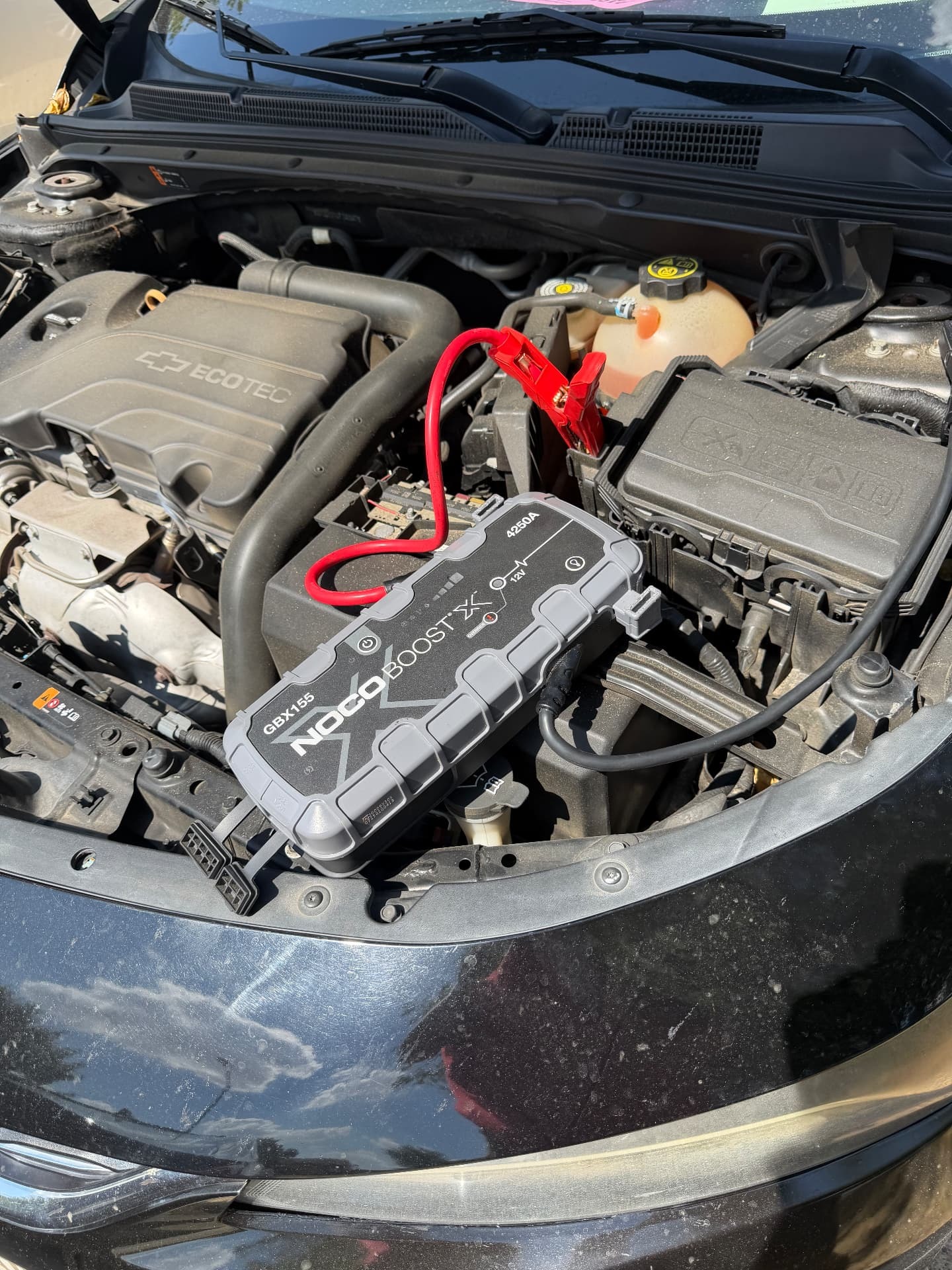
Portable NOCO jump pack connected under an open hood during a roadside jump start in Denton, Texas 76201

Portable jump start in Denton, TX 76201

Denton, TX 76201 jump-start call on September 18, 2026 — a portable NOCO jump pack was connected under the open hood to supply starting power without using a second vehicle.

Denton, TX 76201 · September 18, 2026

Photo © Highway 35 Roadside. All rights reserved. License

See more job photos from across DFW →

Denton roadside FAQ

No matter where you park, we're 20 minutes away.

Don't see your exact breakdown spot? DFW's traffic system is a complex web. If you're broken down near Reunion Tower, a DART station in Plano, Buc-ee's in Denton, or a hidden garage in Las Colinas — here's what to do right now:

  1. 1Turn on hazard lights. Save your battery by switching off A/C and radio.
  2. 2Pin your location. Use Google Maps "Share Location." On the Sam Rayburn Tollway, note the nearest mile marker.
  3. 3Tap to call. A dead battery in the Stockyards or a lockout at Stonebriar needs a human voice that knows the landmarks. We service every parking lot from The Star in Frisco down to the Cotton Bowl at Fair Park, 24 hours a day.
Call (469) 340-3500

Need a tech in Denton?

24/7 dispatch across the DFW metroplex. One call, real human, fast ETA.

(469) 340-3500

Live dispatcher, never an automated menu.

Trust & transparency

  • DFW service area

    Named coverage across Dallas, Tarrant, Collin, Denton and nearby counties.

  • Documented process

    Service pages explain the equipment, safety steps and on-site checks used for each job.

  • Published SLA

    Median DFW response 25–45 minutes. Live ETA quoted on the call before dispatch.

  • Editorial policy

    How we source prices, response data, and safety guidance. Read policy

  • Reviewed by Highway 35 Dispatch Operations

    Page last updated 2026-10-21. Corrections welcome at dispatch@highway35roadside.com.